
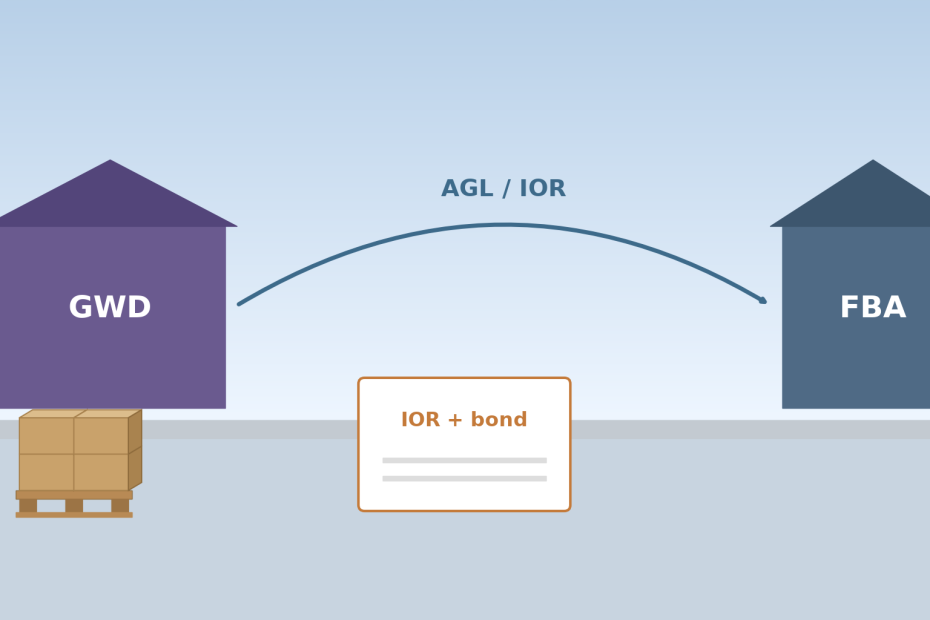
If you want to test Amazon’s Global Warehousing and Distribution (GWD) program, freight is not the first thing to sort out. Your Amazon importer of record is. To use GWD, a brand has to sign up for Amazon Global Logistics (AGL) and name an importer of record on its profile. Amazon will not take that role for you.
Most of the setup is paperwork. However, it has several small steps, and any one of them can hold up a first shipment. Below is what the setup involves, one lesson about customs bonds, and the checklist we would run before a first shipment from Shenzhen.
What GWD is (and is not) in 2026
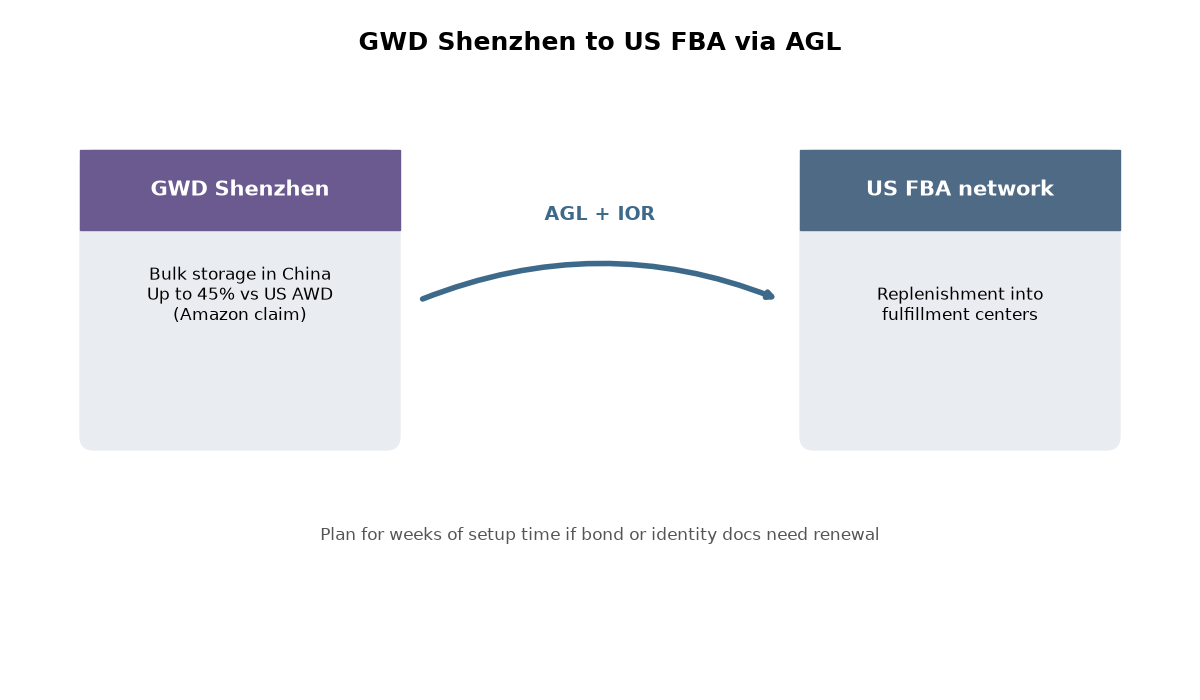
Amazon launched GWD on April 9, 2026, with a facility in Shenzhen. It stores your inventory in China and restocks the US fulfillment network from there. Amazon says storage can cost up to 45% less than US AWD. It also says inventory can reach US fulfillment centers up to seven days faster when you pair GWD with AGL.
You create a GWD shipment from the AWD Create Shipment workflow in Seller Central. If you are not on AGL yet, you sign up as part of getting started.
Amazon’s published GWD fee examples for the Shenzhen hub list storage at around $8.79 per cubic meter per month. Processing and export declaration fees come on top of that. AGL handles and bills the China-to-US transport leg. These are published list rates and they can change, so confirm current fees in Seller Central before you build any cost model.
So what is GWD not? It does not get you around US customs. Your goods still enter the US, and someone other than Amazon has to be the importer. It also does not replace planning. You still decide how much stock to hold in China and when to pull it in.
What the Amazon importer of record setup actually takes
The AGL Freight service terms, dated January 14, 2026, cover the basics. You may name yourself or another party as importer of record, as long as that party is not Amazon. When Amazon’s customs broker handles clearance, the importer must sign a power of attorney and related documents. You also pay the duties, taxes, and clearance charges.
In practice, brands run into four steps.
1. IOR submission
You enter your Amazon importer of record details in Seller Central or on your AGL profile. This names the business that will legally import the goods.
2. POA e-signature
Amazon’s customs broker needs a signed power of attorney to clear goods for the importer. The signature is electronic. Still, decide early who will sign for the importing business.
3. Foreign-owner questions
If the business has foreign owners, expect follow-up questions. Brands have been asked for passport or other identity documents. In one case, Amazon’s onboarding team asked for an ID document showing the signatory’s name in English, and a foreign passport was acceptable. Each request adds another round of back-and-forth.
4. An active continuous customs bond
The importer needs a valid continuous customs bond. Valid is the key word. A lapsed bond does not count.
The expired bond lesson
An expired customs bond is a common blocker. For example, one brand found its bond had expired while it was setting up AGL for a GWD test. That one item can stall a test for months, even when the rest of the setup is done.
How does a bond expire without anyone noticing? Here are a few ways:
- A previous customs broker or forwarder set up the bond, and renewal notices still go to them.
- The person who arranged it has left, so nobody is tracking the renewal date.
- The brand has not imported under its own name for a while, so nothing prompted a check.
So we treat the bond behind your Amazon importer of record as the very first step, not a box to tick at the end. Before anyone books freight, we would:
- Ask the customs broker or bond company (the surety) for the bond’s current status and renewal date, in writing.
- Confirm it is a continuous bond, not a single-transaction bond.
- Put the renewal date on the logistics calendar with one person responsible for it.
- If it has lapsed, start the replacement first and hold the booking until the new bond is active.
An early bond check costs almost nothing. A late one can cost months.
Worked example: setup checklist before the first Shenzhen shipment
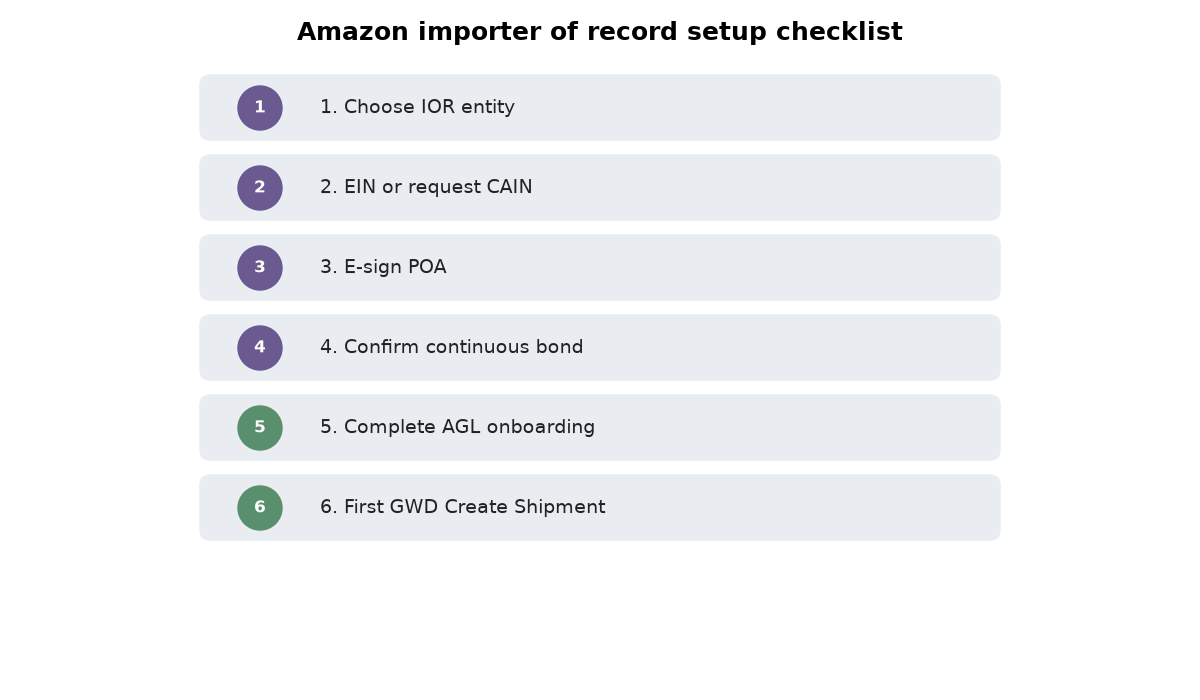
Say an industrial supplies brand imports by container from China and wants to send its first GWD shipment. Here is the order we would work in.
- Decide the IOR. Choose who will be your Amazon importer of record. It can be your own company or another party you designate, but not Amazon.
- Confirm the EIN or CAIN. Check that the importer’s EIN or CAIN is ready. If the importer needs a CAIN and does not have one, request it through Amazon’s flow.
- E-sign the POA. Have the right person sign the power of attorney for Amazon’s customs broker. If the owners are outside the US, have passport or identity documents ready in case Amazon asks for them.
- Confirm the continuous bond. Check that it is active and not expired. Write down the renewal date. If that date falls close to your first shipment, handle the renewal first.
- Complete AGL signup. Finish the AGL profile with the IOR details in place.
- Create the first GWD shipment. Start it from the AWD Create Shipment workflow.
Once step 1 is settled, start the bond check in step 4 right away. It is the step most likely to take time.
How long does all of this take? Plan for weeks, not days, especially if the bond or identity documents need renewing. We would not set a first ship date until steps 1 through 4 are confirmed.
When GWD is worth testing vs US AWD or FBA
Why do brands look at GWD at all? For some, it starts with US inbound placement fees. On bulky goods, those fees can be large. So some brands look at storing inventory in the country where it is made. Stock waits in China, and US restocks get planned ahead instead of rushed.
In our view, GWD may be worth a test if:
- Your products are bulky, so storage and placement fees take a real bite out of your margin.
- You already import from China by container or LTL.
- Your demand is steady enough to plan restocks ahead.
- Your Amazon importer of record setup, including the bond, is in good shape or can be fixed early.
US AWD or shipping straight to FBA may still be the simpler choice if:
- Storage is a small part of your total Amazon fees.
- Your IOR or bond setup is not ready, and your next restock cannot wait.
- You want fewer moving parts while you tighten your forecast first.
Either way, run it as a test. Send part of one product line, compare total landed and storage cost against your current US AWD and FBA costs, and let the numbers decide.
We do not have GWD results of our own to share yet, and we will not guess at savings. Amazon’s 45% figure is an “up to” number. Your result will depend on how much space your inventory takes up, how fast it sells, and the fees in effect when you ship.
Start with what storage costs you today
GWD is one way to lower storage costs. However, it only makes sense once you know what you pay now. The Amazon importer of record setup has to come first. Your current storage numbers tell you whether it is worth doing.
Related guides: Amazon inbound placement fee lesson, Amazon AWD vs FBA, Amazon AWD West Coast distribution centers, Inbound placement fees: reduce or eliminate, and how the free storage costs audit works.
If GWD is on your list, start there. Book a free Storage Costs Audit.